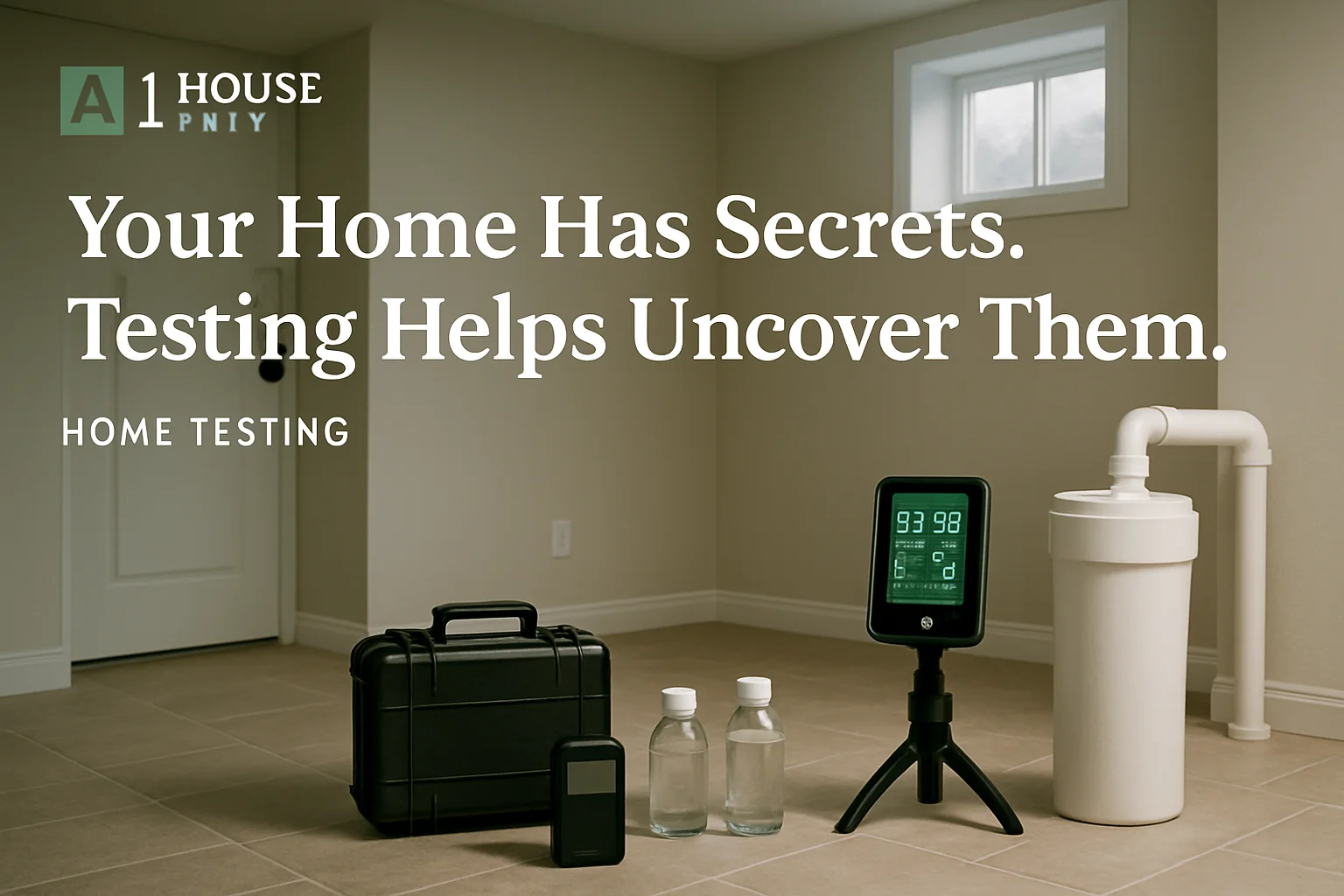
Your Home Has Secrets. Testing Helps Uncover Them.
Most Pennsylvania homes have a story you can’t fully see from the driveway, the listing photos, or even a careful walkthrough. Air moves through wall cavities. Water carries minerals from pipes and plumbing. Soil gas can enter through tiny cracks in foundations. Odors can cling to fabrics and porous surfaces long after the source is gone.
None of that means something is “wrong” with your house. It means homes are complex systems—and some of the most important facts about them are invisible. That’s why home testing uncover hidden issues so effectively: it replaces guessing with clear, practical information you can use.
At A1 House Prep, we help homeowners, buyers, sellers, and real estate professionals across Montgomery County and Bucks County—including Harleysville, Lansdale, Hatfield, Souderton, North Wales, and Blue Bell—get answers through targeted testing and property preparation services. The goal isn’t to alarm you. It’s to give you confidence.
If you’re curious about your home (or you’re preparing for a sale, purchase, or renovation), this guide explains what testing can reveal, when to consider it, and how to use the results wisely.
The “Invisible Home”: Why Secrets Happen
Homes can hide issues simply because many building conditions don’t announce themselves right away. A room can look clean and still have ventilation challenges. Tap water can taste fine and still contain elevated minerals. A basement can feel dry while soil gases move through micro-openings.
These “secrets” tend to fall into a few categories:
- Air you can’t see: ventilation patterns, humidity balance, and contaminants that don’t have a strong smell
- Water you don’t think about: minerals, corrosion byproducts, or other characteristics that vary by source and plumbing
- Conditions that fluctuate: seasonal changes, rainfall, heating/cooling cycles, and occupancy
- Residue from past events: prior smoking, pets, cooking odors, musty storage, or renovation dust
Testing doesn’t turn a home into a laboratory. It simply gives you measured information—so you can make practical decisions without relying on hunches or internet rabbit holes.
Testing Replaces Guessing (Without Scare Tactics)
“Should I be worried?” is a common question. A better question is: “Should I be informed?”
Home testing is most useful when you want to:
- Validate what you suspect (or confirm that your concern isn’t supported by the data)
- Prioritize improvements—so you spend money where it actually helps
- Document conditions for a transaction, renovation, or ongoing home maintenance plan
- Reduce uncertainty when you’re responsible for a property (as an owner, agent, or investor)
Calm, measured testing gives you a clearer picture—especially for conditions that don’t show up as obvious damage.
A Curiosity-First Mindset
Think of home testing like getting the facts before you make a plan. You’re not searching for bad news—you’re clarifying what’s true. Most results lead to simple next steps: improve a habit, adjust maintenance timing, or gather more information before spending on major changes.
What Home Testing Can Reveal (And Why It Matters)
Here are a few common “invisible” areas where homeowners in Pennsylvania often want clarity. Each one has different implications, and not every home needs every test. The point is to match the test to the question you’re trying to answer.
1) Radon: A Quiet Data Point Worth Knowing
Radon is a naturally occurring gas that can enter through foundation openings. It’s not something you can see or smell, and levels can vary from home to home—even on the same street.
A radon test helps you understand your home’s current readings so you can decide what comes next. It’s especially useful when:
- You’re buying or selling a home
- You’ve never tested before (or it’s been years)
- You’re finishing a basement or changing how you use lower-level spaces
- You want a clear baseline for your property records
In places like Montgomery County and Bucks County—where housing stock varies widely by neighborhood, age, and foundation style—testing is often the simplest way to replace assumptions with a real number.
2) Air Quality: When “Fresh” Isn’t Always a Feeling
Indoor air can be affected by moisture, ventilation patterns, building materials, cleaning routines, and occupant lifestyle. Sometimes the clue is obvious (persistent stuffiness or recurring odors). Sometimes it’s subtle: a room that never feels quite right, dust that seems to return quickly, or humidity that swings with the weather.
Air quality testing helps you gather objective information about what may be influencing comfort and indoor conditions. It’s a practical step when:
- You’re troubleshooting a musty or stale smell
- You’ve had a leak, damp basement, or ongoing humidity concern
- You’re preparing a home for listing and want it to show at its best
- You’re moving into a new-to-you property and want to understand the baseline
Testing isn’t about jumping to worst-case conclusions. It’s about turning vague concerns into usable insights so you can decide whether simple changes (like ventilation and humidity control) are worth pursuing.
3) Water Testing: Understanding What Comes Out of the Tap
Water quality can vary by municipality, private well, neighborhood infrastructure, and even the plumbing inside your home. Many homeowners only think about water if there’s a taste, odor, or staining issue—but testing can also be useful as part of a smart maintenance plan.
Water testing can help answer questions like:
- Is the water causing scale buildup or appliance wear?
- Are there characteristics that contribute to staining, odors, or taste issues?
- Do results suggest a need for additional evaluation or treatment options?
For buyers and sellers, it can also support transparency—especially in transactions involving wells or properties with older plumbing.
4) Water Heater Flushing: The Hidden Buildup You Don’t See
Not every “secret” requires laboratory-style testing. Sometimes it’s about what accumulates over time. Sediment can settle at the bottom of many water heaters, potentially affecting performance and efficiency.
A water heater flushing service is a proactive, practical step that homeowners often schedule as routine upkeep—particularly in areas with mineral-heavy water. If you’ve noticed reduced hot water performance, popping sounds, or inconsistent temperatures, it may be time to consider maintenance.
While flushing isn’t the same as water testing, the two can complement each other: testing informs what’s in the water, while flushing addresses the buildup that can result over time.
5) Odors That Linger: When Ozone Is an Option (Used Correctly)
Some odors don’t disappear with basic cleaning. Smoke residue, cooking odors, pet smells, and musty storage can embed into porous materials. When standard deodorizing steps aren’t enough, ozone treatment is sometimes considered as a next-level option.
A1 offers professional ozone machine rentals for odor treatment with an important caveat: ozone must be used only in unoccupied spaces, following all safety instructions and re-entry guidelines. Ozone is not something to “set and forget.” Proper setup, timing, and ventilation afterward matter.
Ozone rentals can be helpful when:
- A property is vacant between tenants or before move-in
- A home is being prepped for listing and needs a reset after odor sources are addressed
- You’ve already cleaned thoroughly and removed the source, but odor remains
It’s not a substitute for fixing moisture problems or removing contaminated materials. It’s a tool—best used thoughtfully and carefully.
When Should You Test? Common Pennsylvania Scenarios
Home testing is valuable at different moments, not just during a crisis. Here are times we frequently see homeowners and professionals in Harleysville, Lansdale, Hatfield, Souderton, North Wales, and Blue Bell decide to test:
- Before listing a home: reduce surprises, support disclosures, and help a home present with confidence
- During a home purchase: add clarity during inspections, especially for baseline radon and water considerations
- After renovations: establish a new baseline after dust-generating or ventilation-changing work
- Seasonal transitions: humidity and ventilation patterns shift between heating and cooling seasons
- After water intrusion: once repairs are made, testing can help confirm conditions and guide next steps
- When you simply want to know: curiosity is a valid reason—especially if you plan to stay long-term
How to Get More Value from Testing Results
Testing is only as helpful as the decisions it supports. A few ways to make results more actionable:
- Start with your question: “What am I trying to understand?” (odor source, baseline radon reading, water characteristics, etc.)
- Consider timing: Some readings can be influenced by season, occupancy, or weather. Ask what timing is most informative.
- Document everything: Keep reports with your home records. They’re useful for future maintenance planning and resale.
- Pair data with observations: Note odors, moisture patterns, or when symptoms appear (after rain, when HVAC runs, etc.).
- Use results to prioritize: Not every finding requires immediate action. Your plan should match your timeline and risk tolerance.
Most importantly, treat testing like a decision tool—not a verdict. You’re building a clearer picture of your property so you can make informed, calm choices.
Local Perspective: Housing Variety Means Testing Matters
One reason testing is so useful in Montgomery County and Bucks County is the variety of housing types. In the same town you may find mid-century homes with finished basements, newer builds with tight building envelopes, and older properties with unique additions or updated plumbing.
That variety can influence airflow, moisture behavior, and how a home interacts with its soil and water supply. In other words: your neighbor’s experience doesn’t always predict yours. Testing personalizes the story to your address.
Who Benefits? Homeowners, Buyers, Sellers, and Real Estate Professionals
- Homeowners: establish baselines, plan maintenance, and reduce nagging unknowns
- Buyers: add clarity before making long-term commitments
- Sellers: reduce last-minute renegotiations and build trust through documentation
- Agents and brokers: support smoother transactions by encouraging clear, measured information
- Investors and property managers: standardize property prep and reduce uncertainty across multiple units
No matter your role, the benefit is the same: fewer assumptions, better decisions.
Want Answers Without the Guesswork?
If you’re ready to learn what your home is really telling you, A1 House Prep can help you choose the right testing and prep services for your goals—whether you’re living in the home, listing it, or preparing to move in.
Call A1 House Prep: 215.853.8226
Request service online: /request-service/
Explore services: Radon Testing | Air Quality Testing | Water Testing | Water Heater Flushing | Ozone Machine Rentals
FAQs: Home Testing That Uncovers Hidden Issues
1) What does “home testing” typically include?
Home testing can include targeted services like radon testing, indoor air quality testing, and water testing. The right mix depends on your property type, whether you’re buying or selling, and what questions you want answered.
2) Do I need testing if my home seems fine?
Not always—but testing can still be valuable as a baseline, especially if you’ve never tested before, you’re planning a renovation, or you want clearer documentation for long-term homeownership. Many concerns are invisible until you measure.
3) How often should radon be tested in Pennsylvania?
Many homeowners choose to test periodically or when major changes occur (like finishing a basement, HVAC changes, or buying/selling). Because homes and conditions vary, it’s best to choose a schedule based on your home’s history and your comfort level with uncertainty.
4) Can air quality testing tell me exactly what’s causing an odor?
Testing can provide clues and data points, but odors can have multiple sources (moisture, materials, past use of the space, ventilation patterns). Results are most helpful when paired with observations about when and where the odor is strongest.
5) Is ozone safe to use for odor removal?
Ozone should be used only in unoccupied spaces and strictly according to the rental guidance and safety instructions, including proper airing-out before re-entry. It’s a specialized tool for odor treatment after the source is addressed—never a casual, in-home “freshener.”
6) Should I test my water if I’m on municipal water?
Municipal water can still vary by neighborhood, plumbing, and home-specific conditions. If you’re noticing taste, odor, staining, or mineral buildup—or you simply want a baseline—testing can provide practical information for next steps.
7) What’s the best way to choose which test to start with?
Start with your biggest unknown. If you’re buying, radon and water questions are common. If you’re troubleshooting comfort or odor, air quality testing may be a logical first step. If you’re unsure, A1 House Prep can help you match your concern to the most practical service.
Closing Thought: Curiosity Is a Smart Homeownership Skill
Homes don’t come with dashboards—but testing gets you closer to one. Whether you’re in Harleysville or Hatfield, Blue Bell or North Wales, the most empowering move you can make is to replace assumptions with information.
When you’re ready to home testing uncover hidden issues in a calm, practical way, A1 House Prep is here to help you take the next step with confidence. Learn more about our approach at A1 House Prep, call 215.853.8226, or request service online.