Would Your Water Pass Your Own Standards?
Most Pennsylvania homeowners have standards for their water—even if they’ve never written them down. You want it to be clear. You want it to taste normal. You want it to feel clean in the shower, keep appliances running smoothly, and make you comfortable pouring a glass for a guest. The tricky part is that water can meet your day-to-day expectations and still leave you wondering what you’re actually dealing with.
That’s where curiosity becomes useful. Not fear. Not rumors. Just a simple homeowner question: would your water pass testing if it had to earn your confidence—not just your routine?
At A1 House Prep, we help homeowners, buyers, sellers, and real estate professionals across Montgomery County and Bucks County get clear, practical answers through professional water testing. If you’re in Harleysville, Lansdale, Hatfield, Souderton, North Wales, or Blue Bell, you’re in a region where water sources and home plumbing histories can vary house to house—even on the same street. Testing replaces guessing with facts you can use.
Your water isn’t “one thing”—it’s a story
When you turn on the tap, what you’re getting depends on multiple layers:
- Source: Public supply, private well, or a blend depending on the area.
- Distribution: Municipal pipes, service lines, neighborhood infrastructure.
- Your home’s plumbing: Age of the home, pipe materials, fixtures, water heater condition.
- Seasonal changes: Rainfall, temperature, and demand patterns can influence taste and odor.
- Water treatment equipment: Softener, filtration, UV, carbon systems—if you have them.
This is why two homes in Montgomery County can have very different “water experiences.” It’s also why it’s hard to rely on assumptions like “the neighbors say it’s fine” or “it’s always tasted OK.”
Premium Perspective: The best water question isn’t “Is it safe?”
A more practical homeowner question is: “Does this water match what my household needs and expects?” Testing isn’t only about extremes—it’s about clarity. Knowing your baseline can help you make smarter decisions about filtration, appliance care, cooking, and future resale conversations.
The invisible parts of water (and why your senses can’t confirm them)
Taste, odor, and clarity matter—but they don’t tell the whole story. Many common water characteristics can’t be reliably detected by smell or sight. On the flip side, a noticeable taste doesn’t automatically mean something is dangerous; it often means something is present at a level you can perceive.
Here are a few examples of “invisible home facts” that testing can help clarify:
- Mineral content (hardness): Hard water can leave scale on fixtures, reduce water heater efficiency, and shorten the life of some appliances.
- pH balance: Water that’s too acidic or too basic can contribute to corrosion or scaling—both can affect plumbing performance over time.
- Metals: Some metals are naturally occurring; others can be influenced by plumbing materials and corrosion.
- Nitrates/nitrites: More common as a concern in some well-water situations and specific land-use patterns.
- Microbial indicators: Not something you can confirm with a glance. This is one reason well owners often choose periodic testing.
Testing doesn’t have to be dramatic. It’s simply a way to replace “maybe” with “here’s what the sample shows.”
Why Pennsylvania-area homes often benefit from water testing
Pennsylvania has a mix of older housing stock, varied geology, and communities that range from suburban developments to semi-rural properties with private wells. In places like Bucks County and Montgomery County, it’s common to see a blend of:
- Homes with long-established plumbing and multiple renovations
- Neighborhoods where municipal water is common but plumbing ages vary widely
- Properties on private wells, especially as you move into less dense areas
- Households using filters without a clear picture of what they’re filtering
If you’re in Harleysville, Lansdale, Hatfield, Souderton, North Wales, or Blue Bell, water testing is a practical way to understand what’s coming into your home right now—not what someone assumes based on the town, the builder, or the listing description.
When homeowners usually ask, “Should we test our water?”
Most people don’t wake up on a random Tuesday and decide to test their water. They get curious because something changes—or because they’re making a decision. Here are common triggers we see:
- Buying a home: You’re inheriting a water system and plumbing history you didn’t live through.
- Selling a home: You want fewer surprises and a smoother inspection conversation.
- New baby or changing household needs: Many families simply want added peace of mind and clarity.
- Taste/odor changes: Especially if the change is new, intermittent, or seasonal.
- Staining or scaling: White buildup, rusty staining, or laundry issues.
- Appliance performance: Water heaters, dishwashers, and humidifiers can reveal water issues early.
- After plumbing work: Changes to pipes, fixtures, or a water heater can shift conditions.
In each case, the goal is the same: move from assumptions to information that helps you choose your next step.
What a water test can help you decide (without guessing)
Homeowners often think testing is only about finding problems. In reality, it’s often about making better decisions:
- Do we need filtration? If so, what type—and for what purpose?
- Is our softener doing what we think it is? Or are we treating the wrong issue?
- Could water conditions be impacting our water heater? If you maintain a tank-style unit, pairing testing with periodic care like water heater flushing can be a smart, practical routine.
- How should we talk about water in a real estate transaction? Clear documentation can reduce back-and-forth.
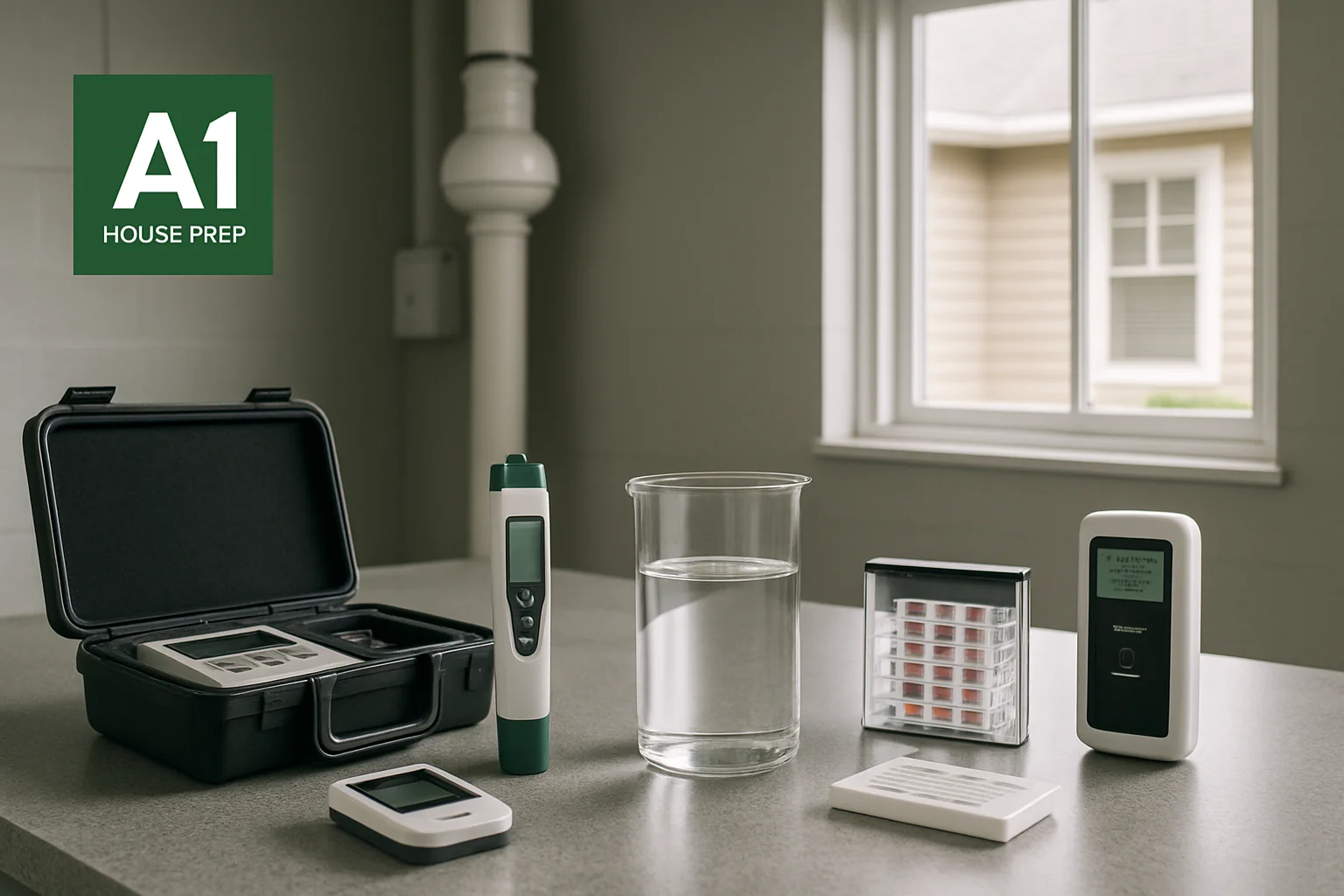
- Are we comparing apples to apples? Not all “home test kits” measure the same things, and results can be hard to interpret without context.
Testing doesn’t force a specific outcome. It simply gives you a clearer map.
Curiosity marketing, homeowner edition: “If we tested today, what would we learn?”
Homeownership has a lot of invisible systems: air, water, radon, humidity, drainage. They work quietly—until they don’t. A1 House Prep’s approach is to make those systems less mysterious with straightforward testing and practical guidance.
If you’re the kind of homeowner who maintains your HVAC, keeps receipts, and likes to stay ahead of surprises, water testing fits that mindset. If you’re more hands-off, testing is still helpful because it sets a baseline you can reference later.
And if you’re a buyer or seller, water testing can be a calm way to replace “I think” with “here’s what we know.”
What about odors in the home—can water be related?
Sometimes homeowners notice odors around sinks, drains, basements, or laundry areas and assume it’s “the water.” Odors can come from many sources, including drain traps, biofilm in pipes, water heater conditions, laundry equipment, or even general indoor air quality.
If your concern is the overall indoor environment, A1 House Prep also offers air quality testing and radon testing to help you build a clearer picture of what’s happening inside the home.
For persistent odor issues in unoccupied spaces, some homeowners and property managers consider controlled odor treatment. A1 House Prep provides professional ozone machine rentals with important safety guidance. Ozone is not a casual “air freshener”—it should only be used in unoccupied spaces, according to instructions, with appropriate ventilation afterward. If you’re unsure whether ozone is appropriate for your situation, ask before you rent.
How the process typically works (and how to prepare)
While every home and goal is different, most water testing follows a simple, homeowner-friendly rhythm:
- Identify your goals: Routine baseline, real estate due diligence, odor/taste questions, well testing needs, or system performance.
- Collect a sample correctly: Sampling method matters. Timing, faucet choice, and whether you’re sampling before or after a filter can change what results mean.
- Review results in context: Numbers are only useful when you understand what they suggest and what your options are.
- Decide on next steps: Sometimes the next step is “do nothing.” Sometimes it’s maintenance, a targeted filtration conversation, or follow-up testing.
If you’re preparing for a test, it helps to note:
- Whether your home uses public water or a private well
- Any filtration/softening equipment and when it was last serviced
- Recent plumbing work or changes
- Specific concerns (taste, staining, odors, appliance scale)
For buyers, sellers, and agents: water testing as a smoother transaction tool
Real estate timelines move fast. Water questions can slow things down when they come up late, when expectations aren’t aligned, or when the “fix” is discussed before anyone has clear information.
Water testing can support a more organized conversation by helping:
- Buyers understand what they’re inheriting and plan accordingly
- Sellers reduce uncertainty and demonstrate transparency
- Agents keep the process calm, documented, and decision-focused
In Montgomery County and Bucks County markets, even small unknowns can feel bigger during negotiations. Clear data has a way of lowering the temperature.
Ready to replace guessing with clear results?
If you’ve been wondering would your water pass testing based on your own standards—not just assumptions—A1 House Prep can help you get practical answers.
Water Testing: /services/water-testing/
Request Service: /request-service/
Call: 215.853.8226
Serving Pennsylvania homeowners and real estate professionals, including Montgomery County and Bucks County (Harleysville, Lansdale, Hatfield, Souderton, North Wales, Blue Bell).
FAQ: Water testing for Pennsylvania homeowners
1) How often should we test our water?
It depends on your water source and your goals. Many homeowners like to establish a baseline and then retest periodically or when something changes (taste/odor, plumbing work, new filtration equipment, or a real estate transaction). Well owners often choose more regular testing than municipal-water households.
2) If my water looks clear and tastes fine, is testing still worth it?
Clear, good-tasting water can still have characteristics that affect plumbing, appliances, or household preferences. Testing can confirm your baseline and help you make more confident decisions—especially if you’re considering filtration or noticing scaling/staining.
3) Can a water test tell me what kind of filter I need?
Testing can help you identify what you’re trying to address (for example, hardness, certain minerals, or other measurable characteristics). That information is often the most practical starting point for deciding whether filtration makes sense and what type to consider.
4) We have a filter already—should we test before or after it?
Sometimes both are useful. Testing “before” shows what’s entering your home, and testing “after” can help you understand what your system is doing. The best approach depends on your question—A1 House Prep can help you choose a sampling plan that matches your goal.
5) Is water testing helpful during a home sale?
Yes—water testing can support clearer disclosures and calmer negotiations by replacing assumptions with documented results. It can also help prioritize practical next steps instead of debating possibilities.
6) Are odors always a water problem?
Not always. Odors can come from drains, plumbing, water heaters, laundry equipment, or indoor air factors. If the issue seems broader than the tap, consider pairing water questions with air quality testing. For certain odor situations in unoccupied spaces, ozone machine rentals may be an option when used strictly according to safety instructions.
Bring your standards to the tap
You don’t need to be suspicious to be informed. Water testing is a practical way to understand your home—especially in a region as varied as Pennsylvania’s suburbs and townships. Whether you’re settling into a new place in Hatfield, preparing a listing in Blue Bell, or simply maintaining your home in Lansdale or Souderton, the goal is the same: clearer facts, better decisions, fewer surprises.
If you’re ready to learn what your water actually says about your home, explore A1 House Prep’s water testing services or request service. Prefer to talk it through first? Call 215.853.8226.