What Invisible Gas Can Enter a Home Through the Ground?
You can’t see it. You can’t smell it. And most homeowners never think about it until a neighbor mentions a test, a home inspector flags it, or a real estate transaction requires clarity. The invisible gas enters home through ground in many Pennsylvania properties is most often radon—a naturally occurring gas that can seep into basements, crawl spaces, and lower levels through tiny openings in the foundation.
This article is designed for curious homeowners (and practical buyers, sellers, and agents) in Montgomery County and Bucks County, including Harleysville, Lansdale, Hatfield, Souderton, North Wales, and Blue Bell. We’ll keep it calm and clear: what the gas is, how it gets in, why “guessing” isn’t helpful, and how testing gives you real, actionable information.
The Invisible Gas: Radon (and Why It Comes From the Ground)
Radon is a colorless, odorless gas created as uranium naturally breaks down in soil and rock. Because it forms underground, it can move up through the earth and enter buildings above it. In Pennsylvania—where geology and housing styles vary neighborhood to neighborhood—radon is common enough that testing is a standard best practice for many homes, especially those with basements or lower levels.
If you’re searching for the phrase invisible gas enters home through ground, radon is usually what you’re hearing about. The key point is simple: radon isn’t about cleanliness or how well you maintain your home. It’s about natural conditions below the structure and the air pressure differences that can pull soil gases inside.
How Radon Enters a Home: Everyday Openings You’d Never Notice
Homes are not sealed containers. Even well-built, well-maintained houses have minor openings where soil gases can travel. Radon can enter through:
- Foundation cracks (hairline cracks count)
- Control joints in basement slabs
- Sump pits and sump pump penetrations
- Gaps around plumbing, utility lines, and conduit
- Crawl space floors (especially exposed soil or older vapor barriers)
- Floor drains or other openings to soil-adjacent spaces
- Construction gaps where slabs meet foundation walls
One of the most surprising things for homeowners in places like Lansdale, Hatfield, and Souderton is that radon entry points can be incredibly small. You might not notice anything “wrong” with your basement—and that’s exactly why testing is so valuable. It replaces guesswork with a measurable result.
Why Some Homes Have Higher Levels Than Others (Even on the Same Street)
Radon can vary widely from one property to the next. Two homes in Blue Bell or North Wales can have very different readings due to a combination of:
- Soil composition and local geology
- Foundation type (basement, crawl space, slab-on-grade)
- Air pressure differences between the home and the soil (stack effect, HVAC operation, exhaust fans)
- Seasonal changes (closed-window months can behave differently than open-window months)
- Renovations that change airflow or create new openings
This is also why “my neighbor tested low” isn’t a reliable indicator. Radon is a property-specific measurement. Testing is the only dependable way to know what’s happening in your home.
A1 House Prep Insight: Invisible Doesn’t Mean Unknowable
The most homeowner-friendly approach to radon is curiosity backed by data. If you’re in Montgomery County or Bucks County, a simple test can provide clarity—especially if you’re finishing a basement, planning a home sale, or buying a property where you want fewer surprises later.
Signs You Can’t Rely On (and What to Do Instead)
Because radon is invisible and odorless, you generally won’t get “clues” like you might with a plumbing leak or a musty smell. Common misconceptions include:
- “My basement smells fine, so I’m good.” Odor is not a radon indicator.
- “It’s a newer home.” New construction can still have radon entry points.
- “We keep windows open.” Ventilation patterns change; results can vary.
- “We don’t use the basement.” Air moves through the whole home.
The practical next step is straightforward: test. A professional radon test provides a snapshot of what’s happening during the test period and helps you decide what (if anything) should happen next based on real information.
When Testing Makes the Most Sense (Homeowners, Buyers, Sellers, and Agents)
Radon testing isn’t only for one type of homeowner. In our local Pennsylvania market—Harleysville to Hatfield, Lansdale to Blue Bell—it comes up in multiple situations:
For homeowners
- When moving into a home you’ve owned for years but never tested
- After basement finishing or major renovations that affect airflow
- If you’re curious and want a baseline measurement for peace of mind
For buyers
- As part of a broader due diligence approach during inspection
- To understand the property’s baseline conditions before moving in
For sellers
- To reduce last-minute surprises during negotiations
- To answer buyer questions with documentation
For real estate professionals
- To keep transactions on schedule with clear testing timelines
- To help clients focus on facts, not speculation
If your goal is a clear, professional evaluation, start here: Radon Testing.
What a Professional Radon Test Looks Like (Plain-English Overview)
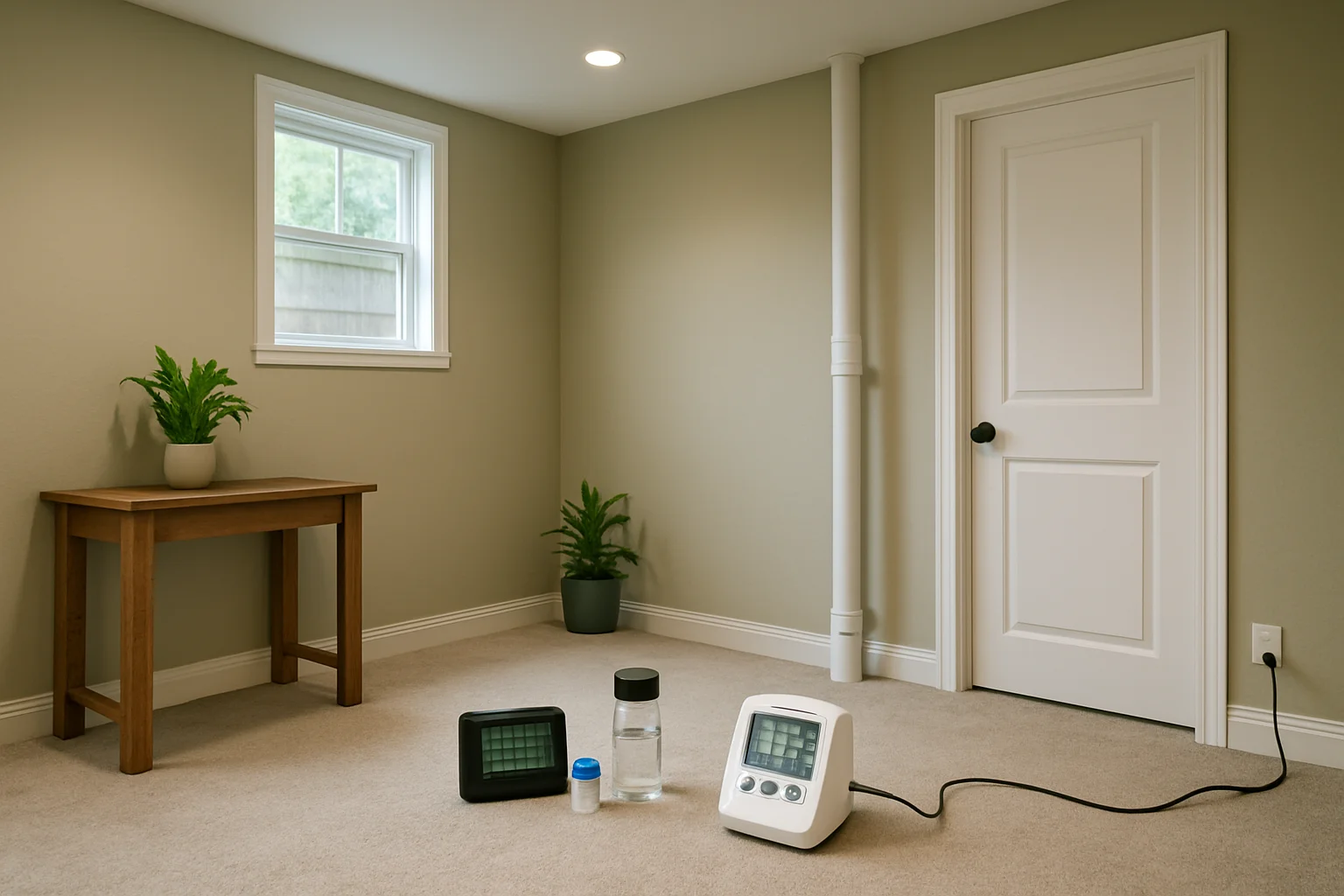
Radon testing is designed to be simple for the homeowner and reliable for decision-making. While exact procedures vary depending on the home and purpose (for example, a real estate timeline), professional testing commonly involves:
- Choosing the right placement (often the lowest livable level)
- Maintaining closed-house conditions when required (typical for short-term tests)
- Documenting the test period and conditions
- Retrieving the device and providing results
What homeowners appreciate most is that the process is non-invasive and focused. You’re not tearing into walls; you’re collecting data and making informed choices from there.
In many Pennsylvania homes, radon questions come bundled with other “invisible” concerns—like indoor air quality, humidity-related odors, or water quality. If you’re taking a broader look at the home’s environment, A1 House Prep also offers Air Quality Testing and Water Testing.
“If It’s Invisible, How Do I Improve My Confidence?” A Practical Home Prep Mindset
A premium home-prep approach is rarely about overreacting. It’s about reducing unknowns. Consider this simple framework:
- Identify what you can’t see (radon, air quality factors, water quality variables).
- Test before you assume (data prevents wasted effort and anxiety).
- Use results to prioritize (decide what matters now vs. later).
- Document for future decisions (especially helpful for real estate).
This is particularly useful in older housing stock around Montgomery and Bucks Counties, where homes may have been updated over time and airflow or foundation conditions can vary widely.
Related Curiosity: Odors vs. Gases (and Where Ozone Fits)
Homeowners sometimes connect “gas” with “smell.” Radon is different: it has no odor. If you’re dealing with stubborn odors (smoke, musty smells, cooking odors, pet odors), you’re in a different category of problem-solving—often tied to indoor air quality, moisture, materials, and ventilation.
In some cases, professional-grade ozone machines are used for odor treatment, but they require careful handling and clear boundaries. If you’re considering this route, A1 House Prep offers Professional Ozone Machine Rentals with guidance.
Important safe-use reminders for ozone (odor treatment)
- Use in unoccupied spaces only: people and pets should not be present during operation.
- Follow all instructions for run time, room size, and ventilation.
- Allow time to air out the area before re-entry, as directed.
- Ozone is not a radon solution: it does not test for or address radon entry from the ground.
The takeaway: odors are sensory; radon is not. Treat each with the right tool—testing for radon, and appropriate odor/air-quality strategies for smells.
Local Pennsylvania Perspective: Why Radon Comes Up So Often Here
In communities like Harleysville, Lansdale, Hatfield, Souderton, North Wales, and Blue Bell, homes often include basements and lower levels that naturally interact with soil conditions. Add seasonal weather swings—humid summers and tightly sealed winter months—and it’s easy to see why radon is a recurring topic in property conversations.
The good news is that radon is a well-known, well-studied issue with a straightforward first step: measurement. If you’re preparing a home for sale, purchasing a property, or simply maintaining your home at a premium standard, testing supports confident decisions.
Ready to Replace Guesswork with a Professional Radon Test?
If you want clear, homeowner-friendly guidance and professional testing in Montgomery County or Bucks County, A1 House Prep is here to help. Start with our Radon Testing service page or request an appointment online.
- Request Service: /request-service/
- Call A1 House Prep: 215.853.8226
Prefer a whole-home “invisible factors” check-in? Explore Air Quality Testing and Water Testing as complementary options.
FAQ: Invisible Gas Enters Home Through Ground (Radon) Questions
1) What invisible gas enters home through ground in Pennsylvania?
In many cases, the invisible gas enters home through ground is radon, a naturally occurring gas that forms in soil and rock and can move into homes through small openings in foundations and slabs.
2) Can I tell if my home has radon without testing?
Typically, no. Radon has no smell or color, and homes with radon don’t necessarily have visible warning signs. Testing is the reliable way to understand your home’s levels.
3) Do newer homes in places like North Wales or Blue Bell still need radon testing?
New construction can still allow radon entry through tiny gaps and penetrations. Because radon is driven by soil conditions and pressure differences, age alone doesn’t rule it out. Testing provides a clear baseline.
4) When is the best time of year to test for radon?
Radon can be tested year-round. Results can vary seasonally, and some test types have specific setup considerations. If you’re in a real estate timeframe, testing is often scheduled to align with inspection and contingency periods.
5) Is radon only a basement issue?
Radon often enters through the lowest levels, but air can circulate throughout the home. Testing is typically performed on the lowest livable level to understand potential exposure where the home is used.
6) I have a musty smell—does that mean I have radon?
Musty odors are more commonly connected to moisture and indoor air quality factors, not radon. Because radon is odorless, smell isn’t a dependable indicator either way. Consider Air Quality Testing for odor-related investigation, and Radon Testing for radon-specific measurement.
7) Can ozone treatment help with radon?
No—ozone is sometimes used for odor treatment in unoccupied spaces under controlled instructions, but it is not a radon test and not a radon solution. If radon is your concern, start with professional radon testing.