The Water Test Many Home Buyers Forget to Ask About
There’s a moment in almost every home search when the big questions start getting answered: How old is the roof? What’s the furnace situation? Is there radon? But one of the most important “invisible facts” about a property often stays in the background until after closing—if it comes up at all.
In Pennsylvania, especially across Montgomery County and Bucks County communities like Harleysville, Lansdale, Hatfield, Souderton, North Wales, and Blue Bell, the water source and water quality story can vary from neighborhood to neighborhood—even from one street to the next. That’s why the water testing home buyers forget isn’t a niche item; it’s a practical step that replaces guessing with clarity.
The forgotten question: “What are we actually drinking?”
Home inspections do a lot, but they don’t automatically answer everything about water quality. Many buyers assume that if water is clear and doesn’t smell, it’s “fine.” And many sellers assume that if they’ve lived in a home for years without noticeable issues, testing isn’t necessary.
The reality is calmer and more straightforward: water has characteristics you can’t reliably sense. It can look normal, taste normal, and still be worth checking—especially when you’re making a long-term investment.
Water testing isn’t about alarm. It’s about understanding a property’s baseline. That baseline can help you:
- Confirm what’s typical for the area and the home’s water source
- Identify common regional issues early (before they become surprises)
- Make informed decisions about maintenance, filtration, or next steps
- Create a clear record for future planning and home care
Why this gets missed in Pennsylvania real estate transactions
There are a few reasons water testing often slips through the cracks during busy purchase timelines:
- Assumptions about “public water.” Buyers often assume municipal water always means “no need to test.” But the water entering the home is only one piece of the puzzle; the home’s plumbing and fixtures can still influence what comes out of the tap.
- Well water uncertainty. If a property has a private well, some buyers aren’t sure what to ask for or which tests are appropriate. They may avoid the topic rather than risk delaying a deal.
- Inspection focus goes to visible systems. Roofs, grading, HVAC, and electrical issues are tangible and time-sensitive. Water quality feels less urgent because it’s not always visible.
- “It tastes fine.” Taste is a poor measuring tool. Some concerns aren’t detectable without testing, and some noticeable tastes/odors can come from harmless sources. Testing provides context either way.
- Busy schedules and short contingency windows. When everything is happening at once, buyers prioritize the obvious. A water test can be a simple addition that pays off in confidence.
The specific water test many home buyers forget: testing at the tap (not just the source)
When water comes up in a transaction, it’s often framed as “well vs. public.” That’s a starting point, but the more practical question is: what is the quality of the water at your fixtures—kitchen sink, bathroom taps, and any point where you’ll actually use it?
Testing “at the tap” helps you understand:
- House-specific factors like aging plumbing, sediment, or corrosion impacts
- Variability between cold and hot water lines (useful when investigating odor or staining)
- Real-life use conditions rather than theoretical source quality
This is a major reason water testing home buyers forget matters. People may request a generic report or rely on broad municipal data, but the everyday user experience is still shaped by the property itself.
Curiosity pays off: “What would we learn if we tested?”
Most water testing conversations don’t start with a problem. They start with curiosity—especially for buyers moving into a new area or a different type of home. A simple water test turns unknowns into knowable facts, without relying on assumptions, anecdotes, or guesswork.
What a practical home-buyer water test can cover
The “right” water test depends on the property and water source. In our Pennsylvania service area, homeowners and buyers commonly want clarity on a few categories:
1) Basic water quality indicators
- pH (helps describe how acidic/alkaline the water is)
- Hardness (often tied to scaling, soap performance, and appliance efficiency)
- Iron and manganese (can contribute to staining and discoloration)
- Turbidity (a measure related to clarity/suspended particles)
2) Bacteria screening (especially relevant for private wells)
For properties on well water, buyers often ask about bacterial indicators. This is common in rural and semi-rural areas throughout Montgomery and Bucks Counties where wells are more prevalent.
3) Nitrates/nitrites and other “context” tests
Depending on the location and property surroundings, buyers may request additional screening to better understand water conditions. Your testing plan should match the home’s story: water source, plumbing type, age of the home, and any visible clues like staining, odor, or sediment.
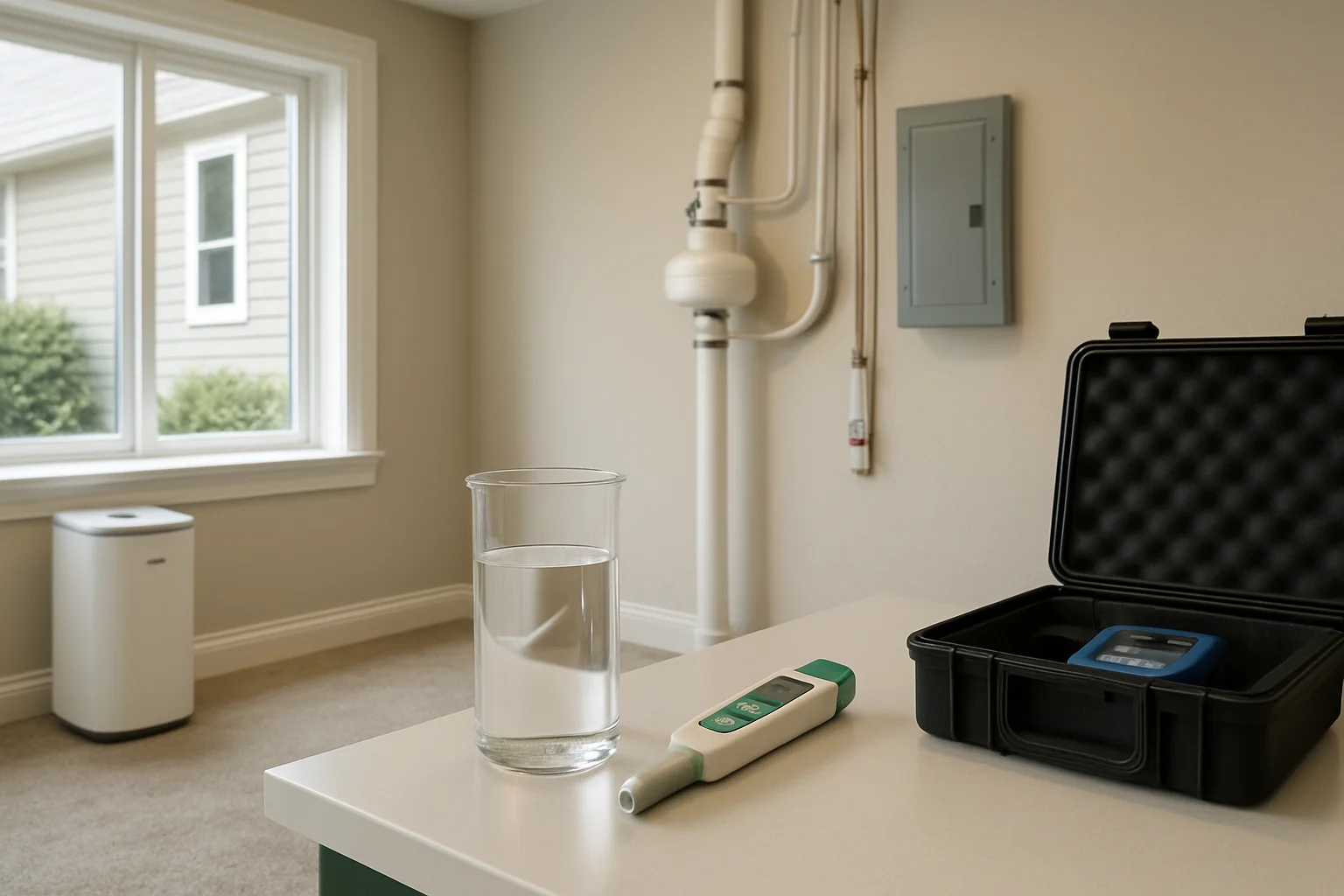
For a tailored recommendation based on your home or a property you’re buying, A1 House Prep offers professional water testing with clear, homeowner-friendly guidance.
Clues that say “test the water before you close” (without panic)
You don’t need a dramatic red flag to justify testing. But certain details can make a water test especially worthwhile during your inspection window:
- Unknown water source history (you’re not sure how long the home has had a well or whether it has been serviced)
- Staining in tubs, toilets, or sinks (orange, black, or bluish/green tints)
- Odor that’s intermittent (for example, only on hot water or only after the water sits)
- Sediment in aerators, showerheads, or at the bottom of toilet tanks
- Older plumbing or visible corrosion on fixtures
- Water heater age and signs of scaling (a maintenance clue that can affect water experience)
These aren’t reasons to assume the worst. They’re reasons to get data. The goal is a calm, informed “here’s what we’re working with” approach.
How water testing helps buyers, sellers, and agents
For home buyers
- Confidence in what you’re moving into
- Negotiation clarity (if something needs attention, you have documentation rather than speculation)
- Planning for any filtration, softening, or maintenance priorities
For home sellers
- Fewer surprises when buyers ask questions mid-transaction
- Clear disclosure support with a straightforward report
- Trust-building through transparency
For real estate professionals
- Smoother transactions by addressing a common “late discovery” item early
- Better client service with practical, non-alarmist recommendations
- Local relevance for clients moving across Montgomery/Bucks County lines where water conditions can vary
Water quality is part of the “whole-home” picture
Water testing sits alongside other invisible-home facts that smart buyers check early. If you’re the kind of homeowner who prefers confirmation over assumptions, consider building a simple baseline of the home’s indoor environment:
- Air Quality Testing to better understand indoor conditions
- Radon Testing for a clear read on an odorless, invisible risk factor
- Water Testing to understand what’s coming out of the tap
Each test answers a different question. Together, they can make a home feel less like a mystery and more like a well-understood investment.
A quick note on odors: don’t confuse water issues with air issues
“The house has a smell” is a common comment during showings. Sometimes that’s related to drains, water heaters, or plumbing. Other times it’s tied to indoor air factors (pets, smoke residue, humidity, or long vacancy).
If your concern is primarily odor (not the water itself), A1 House Prep offers professional ozone machine rentals for odor treatment in unoccupied spaces only. Ozone should be used carefully and according to instructions:
- Only run ozone equipment when the home is unoccupied (no people, pets, or plants)
- Allow adequate time for the space to air out before re-entry
- Follow all provided safety guidance and rental instructions
When the question is “Is this smell coming from the water?” a water test can help separate a water-related cause from an indoor air or maintenance-related cause—without guessing.
What to ask for: a simple checklist for buyers
If you’re within your inspection window (or preparing to make an offer), these questions keep the process practical:
- Is the home on public water, community water, or a private well?
- Where should the sample be taken—kitchen tap, bathroom, or another point of use?
- Are there visible clues (staining, sediment, odor) that suggest specific testing?
- What is the age/condition of the water heater, and has it been maintained?
- Can we schedule testing early enough to review results before contingencies end?
If you want to pair testing with simple maintenance, A1 House Prep also provides water heater flushing, a practical service that can support system performance and help reduce sediment-related issues over time (when appropriate for the unit’s condition).
Local perspective: why Montgomery & Bucks County buyers benefit from testing
In communities like Harleysville, Lansdale, Hatfield, Souderton, North Wales, and Blue Bell, home styles and water sources vary widely. You can tour two homes built the same year and have completely different water experiences based on plumbing updates, fixture condition, or whether the property is served by a well versus a municipal system.
A local, homeowner-focused approach to water testing helps keep the conversation grounded: not “What could be wrong?” but “What do we know, and what does it mean for this home?”
FAQ: Water Testing for Home Buyers in Pennsylvania
1) What is the most overlooked water test home buyers should consider?
Testing at the point of use (at the tap) is commonly overlooked. Buyers may rely on general water source information, but the home’s plumbing and fixtures can influence what you actually experience day to day.
2) Should I test water if the home is on public water?
Many buyers still choose to test for peace of mind and to understand the home’s baseline. Public supply data can be helpful, but it doesn’t always reflect conditions inside an individual property’s plumbing.
3) How soon should water testing happen during the buying process?
Schedule it as early as possible within your inspection contingency window. That timing gives you room to review results calmly and decide if any follow-up questions are needed.
4) What if the water has an odor or leaves stains—does that automatically mean a serious problem?
Not automatically. Odor and staining can come from a range of causes, some simple and some more involved. Testing helps narrow the possibilities so you can make decisions based on information rather than assumptions.
5) Are well-water homes in Bucks and Montgomery Counties “riskier” to buy?
Not necessarily. Well-water homes can be great. They simply come with different homeowner responsibilities and a stronger need for periodic testing and maintenance planning.
6) Can water testing help real estate transactions go smoother?
Yes. Clear documentation can reduce uncertainty and prevent last-minute surprises. It’s a straightforward step that supports transparency for both buyers and sellers.
Ready to replace guessing with clear water facts?
If you’re buying, selling, or simply curious about your home’s water in Pennsylvania, A1 House Prep provides professional water testing with clear communication and practical next steps.
Call A1 House Prep: 215.853.8226
Request service online: /request-service/
Serving homeowners and real estate professionals across Montgomery County and Bucks County, including Harleysville, Lansdale, Hatfield, Souderton, North Wales, and Blue Bell.