Can Sprays Hide a Smell Without Solving It?
It’s a familiar Pennsylvania homeowner moment: you walk in the front door and something smells… off. Maybe it’s a musty basement in Harleysville after heavy rain, last night’s cooking lingering in Lansdale, a “pet” note in a carpeted room in Hatfield, or that sweet chemical odor that shows up after a DIY project in North Wales. The fastest fix is usually a spray—air freshener, deodorizer, “odor eliminator,” or a scented candle.
But here’s the curiosity worth following: sprays hide smells without removing odor more often than people realize. Many products can change what you perceive (masking) without addressing what’s producing the smell (the source). That difference matters for comfort, resale, and peace of mind—especially for buyers, sellers, and agents preparing a home to show in Montgomery County and Bucks County.
This article breaks down what sprays can and can’t do, why odors come back, and how a calmer, more practical approach—testing and targeted treatment—can replace guessing. You’ll also learn when a professional ozone machine rental can be appropriate, and why it must be used only in unoccupied spaces with careful, common-sense safety steps.
Masking vs. Removing: Why the Smell Keeps Returning
Most odor “sprays” fall into a few categories:
- Fragrance masking: Adds a stronger scent so you notice it instead of the original odor.
- Neutralizers: Uses chemicals intended to bind to odor compounds and reduce smell intensity.
- Disinfecting/deodorizing sprays: May reduce certain microbes on surfaces, but typically only where sprayed and not deep in porous materials.
Even when a product truly reduces odor compounds in the air, it often doesn’t reach the source. That’s why the smell fades for a few hours (or a day), then returns—especially when the house warms up, humidity rises, or the HVAC kicks on.
In practical terms, sprays hide smells without removing odor when the odor is being fed by something ongoing: moisture, a hidden spill, buildup in a drain, contamination in porous materials, or air movement pulling odor from a wall cavity. The scent might be “covered,” but the underlying condition hasn’t changed.
The “Invisible Home Facts” Behind Common Odors
Odors are information. They’re not always an emergency, and they’re not always simple. What matters is being curious and systematic. Here are common “invisible facts” that can create persistent smells in Pennsylvania homes:
1) Moisture and hidden dampness
Musty odors often point to damp materials: basement walls, crawl spaces, subfloors, or insulation. In Blue Bell or Souderton, even a small seasonal moisture pattern can make a basement smell “earthy,” especially when humidity rises.
2) VOCs from products and materials
Paints, finishes, adhesives, new flooring, and stored chemicals can release volatile organic compounds (VOCs). A spray may temporarily cover the odor while the VOC source continues off-gassing.
3) HVAC distribution (the odor’s “delivery system”)
Sometimes the issue isn’t just the source—it’s how air moves. Returns, supply ducts, and pressure differences can spread odor from one room to another. This is why a smell might be strongest near a vent or only when the system runs.
4) Porous materials holding onto odor
Carpet padding, upholstered furniture, unfinished wood, and drywall can absorb odors. Cleaning the surface may help, but deep odor can remain, especially with smoke, pet accidents, or long-term cooking buildup.
5) Plumbing and drain issues
Dry traps, biofilm, or venting issues can produce sour, sulfur, or “stale” smells that come and go. A spray in the bathroom changes the perception, not the cause.
When “Fresh” Is a Red Flag in Real Estate (Without the Drama)
For buyers and agents, heavy fragrance can raise questions. Not because it automatically means a serious issue—but because it can signal uncertainty. In a showing, a very “freshened” home may make people wonder what’s being covered.
For sellers, this is good news: you don’t need to over-fragrance a property. A calmer approach typically shows better:
- Start with a clean baseline: remove trash, launder fabrics, wipe surfaces.
- Address moisture and ventilation first (dehumidifiers, fans, air exchange).
- Use targeted odor treatment when appropriate.
- Confirm “invisible facts” with testing instead of guessing.
A1 House Prep supports homeowners and real estate professionals across Montgomery County and Bucks County with practical home testing and preparation services—helping you move from “maybe it’s nothing” or “maybe it’s big” to “here’s what the home is telling us.”
Testing Replaces Guessing: What to Check Before You Keep Spraying
If an odor is persistent or recurring, it’s worth stepping back and asking: What could be feeding it? You may not need a major project—just better information.
Air quality testing for clarity
If the smell seems “chemical,” “stale,” or triggers questions about indoor air, Air Quality Testing can help create a baseline. Testing can help you understand whether an odor complaint is likely tied to indoor air conditions rather than just a temporary smell event.
Water testing when odor seems to come from faucets
If the smell is strongest at sinks or showers (rotten egg, metallic, or chlorine-like), it may be related to water quality or hot water equipment. Water Testing can be a useful step—especially for homes on well water or where conditions changed after plumbing work.
Water heater maintenance for “hot water smell” situations
Some odor complaints show up mainly with hot water. Sediment and buildup can contribute to unpleasant hot water characteristics over time. If you’re due for maintenance, consider water heater flushing as part of a broader “eliminate the source” plan.
Radon testing (separate issue, still an invisible fact)
Radon is different from odor—it’s typically not something you smell. But it’s a good example of why guessing isn’t a strategy. If you’re buying, selling, or simply want more certainty about your home in Pennsylvania, Radon Testing offers objective data for an invisible factor that doesn’t announce itself.
Premium Home Prep Mindset: Treat Odor Like a Clue, Not a Crisis
Most odor issues become stressful when they stay vague. A calmer approach is to define the problem before you try to “fix” it: identify where the smell is strongest, when it appears, what changes it (humidity, HVAC, time of day), and whether it’s linked to water use or specific rooms. Pair that observation with targeted testing, and you’ll make smarter, more cost-effective decisions—without scare tactics.
Where Sprays Can Help (and Where They Often Don’t)
Sprays aren’t “bad.” They’re just limited. Here’s a realistic framework:
Sprays can help when:
- The odor is short-term and airborne (cooking, a brief pet smell, a one-time spill that’s already cleaned).
- You need a temporary improvement before deeper cleaning (for example, while laundering fabrics or ventilating).
- You’re using an unscented neutralizer as a small part of a broader plan.
Sprays often don’t solve the problem when:
- The source is inside porous materials (carpet pad, drywall, wood framing).
- Moisture is present or recurring (basement dampness, condensation, leaks).
- The odor is being distributed via HVAC or pressure differences.
- The smell is coming from drains, plumbing vents, or mechanical areas.
- There’s an ongoing contributor (stored chemicals, litter boxes, smoke residue, hidden spills).
When you find yourself spraying repeatedly, it’s usually a sign that the home is giving you a consistent signal. That’s the moment to shift from “cover it” to “confirm it.”
If the Odor Is Set Into the Space: When Ozone Can Be the Right Tool
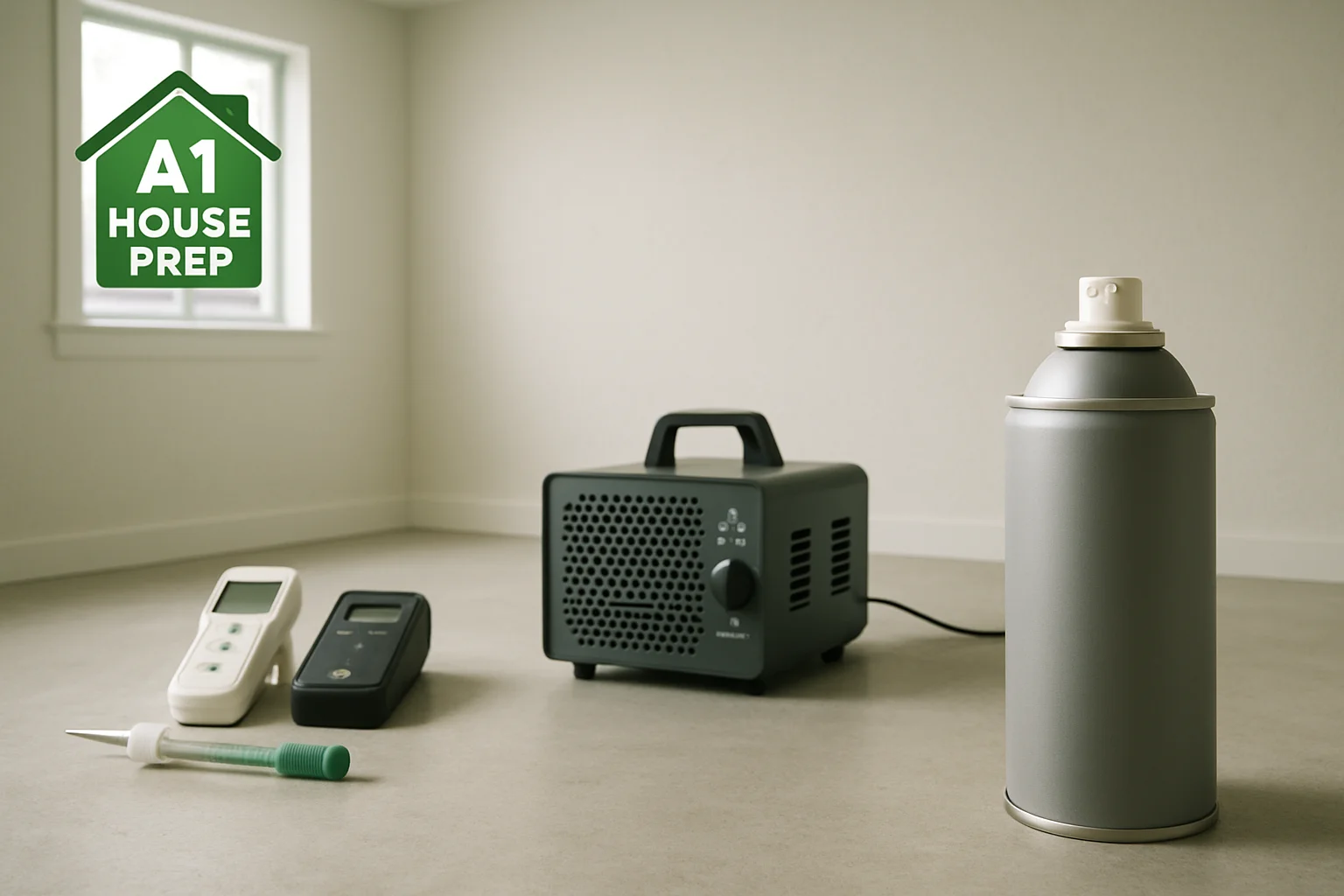
For certain stubborn odor situations—especially after deep cleaning and source removal—ozone treatment can be used to help reduce lingering odors in a space. This is where Professional Ozone Machine Rentals may fit into a homeowner’s plan, particularly for:
- Smoke-related odors (after cleaning and removal of obvious residue sources)
- Pet odors that persist after proper cleaning and extraction
- Cooking odors embedded in soft materials
- “Closed-up home” odors after vacancy (combined with ventilation and cleaning)
Important: ozone is not a casual “air freshener.” It’s a tool to be used thoughtfully and only in the right scenario. Ozone treatment is typically considered after you’ve removed or cleaned the source as much as possible. Otherwise, you may be treating symptoms while the source continues producing odor.
Ozone Safe-Use Basics (Unoccupied Spaces Only)
A1 House Prep focuses on practical, homeowner-friendly guidance. If you’re considering an ozone machine rental, plan on using it in a way that prioritizes common-sense safety and the manufacturer’s instructions.
- Use only in unoccupied spaces: People and pets should not be in the area being treated. Remove plants as well.
- Plan treatment time intentionally: More is not always better. Follow the unit’s guidelines and match the run time to the size and condition of the space.
- Seal and stage the space: Close windows and doors for treatment, and open interior doors if treating multiple connected areas (only if appropriate for your situation and guidance).
- Ventilate thoroughly afterward: Air out the space before re-entry—open windows, run fans, and allow time for the space to return to normal.
- Don’t use ozone as a substitute for cleaning: Remove obvious odor sources first (soiled items, trash, contaminated padding, etc.).
- Be cautious with sensitive materials: Some items (rubber, certain fabrics, electronics) may be affected by oxidation. When in doubt, remove valuables or consult the equipment guidance.
If you’re unsure whether ozone is appropriate for your particular odor situation, A1 House Prep can help you think through the scenario based on the home’s details and your goals, especially for property preparation prior to listing or after tenant turnover.
A Practical “No-Guess” Odor Plan for Pennsylvania Homes
Whether you’re a homeowner in Blue Bell preparing for guests, a seller in Lansdale getting ready for photos, or an agent coordinating a smoother showing in Hatfield, this step-by-step approach keeps things calm and effective:
- Identify the pattern: Where is it strongest? When is it worst (morning, humid days, after HVAC runs)?
- Remove obvious sources: Trash, old filters, wet cardboard, pet items, damp towels, stored chemicals.
- Deep clean strategically: Focus on porous materials and “odor-holding” zones (carpets, upholstery, unfinished basement areas).
- Control moisture and airflow: Dehumidify basements, vent bathrooms, and consider HVAC filter replacement and ventilation.
- Confirm the invisible factors: Use air quality testing or water testing when the smell suggests a broader source.
- Consider ozone only when appropriate: After cleaning/source removal, for stubborn residual odors, in unoccupied spaces only. See ozone machine rentals.
- Reassess: If the odor returns, it’s data—go back to the pattern and look for what’s still feeding it.
This approach avoids overreacting while still taking the home’s signals seriously. It also helps prevent the frustrating cycle of repeated spraying with temporary relief.
Local Notes: Why Odors Can Be Seasonal in Montgomery & Bucks County
In Pennsylvania, odor complaints often fluctuate with weather:
- Humidity spikes: Summer humidity and storm cycles can intensify basement mustiness and make older materials smell stronger.
- Heating season: First furnace runs can move dust and “stored” odors; closed windows reduce fresh air exchange.
- Shoulder seasons: Spring and fall bring temperature swings that change indoor pressure and airflow, sometimes pulling odors from basements or wall cavities into living areas.
If a home in Souderton or North Wales smells fine most of the year but becomes noticeable during a particular season, that pattern is useful. It often points to moisture, ventilation, or HVAC-driven distribution—problems you can evaluate and address with a targeted plan.
Want to Replace Guessing With a Clear Plan?
If you’re dealing with an odor that keeps returning—or you’re preparing a home for listing in Montgomery County or Bucks County—A1 House Prep can help you take the next practical step. Explore Professional Ozone Machine Rentals for stubborn residual odors (unoccupied spaces only), or request guidance based on your home’s situation.
Call A1 House Prep: 215.853.8226
Request Service: /request-service/
FAQs: Sprays, Odors, and Ozone Treatment
1) Is it true that sprays hide smells without removing odor?
Often, yes. Many sprays primarily mask with fragrance or only reduce airborne odor briefly. If the odor source remains (moisture, porous materials, HVAC movement, plumbing issues), the smell typically returns.
2) How can I tell if an odor is in the air or coming from a material?
A quick clue is whether the smell returns in the same spot and gets stronger with humidity or warmth. Odors embedded in carpet padding, upholstery, wood, or drywall frequently intensify with moisture and time, even after spraying.
3) Will ozone remove odors permanently?
Ozone can help reduce certain lingering odors when used correctly, but results depend on whether the underlying source has been removed or cleaned. If the odor source is still present (for example, ongoing dampness or contaminated materials), the smell may come back.
4) Can I stay in the home while running an ozone machine?
No—ozone treatment should be done in unoccupied spaces only. Plan to leave the treated area (including pets), run the machine according to guidance, and ventilate thoroughly before re-entry.
5) What should I do before using an ozone machine for odor?
Start with source removal and cleaning: dispose of odor-causing items, clean affected surfaces, wash fabrics, and address moisture. Ozone is best viewed as a finishing step for stubborn residual odor, not a substitute for cleaning.
6) I’m selling my home—should I avoid scented sprays before showings?
Light, neutral cleanliness usually performs better than heavy fragrance. Over-scenting can create doubt for buyers. A more premium approach is to clean, ventilate, control humidity, and address the source of odors rather than trying to cover them.
7) When should I consider professional testing instead of more deodorizing products?
Consider testing when odors persist beyond normal cleaning, when you suspect a broader indoor air issue, or when you want clearer information for a real estate transaction. A1 House Prep offers Air Quality Testing, Water Testing, and Radon Testing to help homeowners replace uncertainty with data.
If you’re ready to address stubborn odors with a structured plan—without scare tactics—A1 House Prep is here to help homeowners and real estate professionals across Harleysville, Lansdale, Hatfield, Souderton, North Wales, Blue Bell, and surrounding communities. Call 215.853.8226 or request service here.