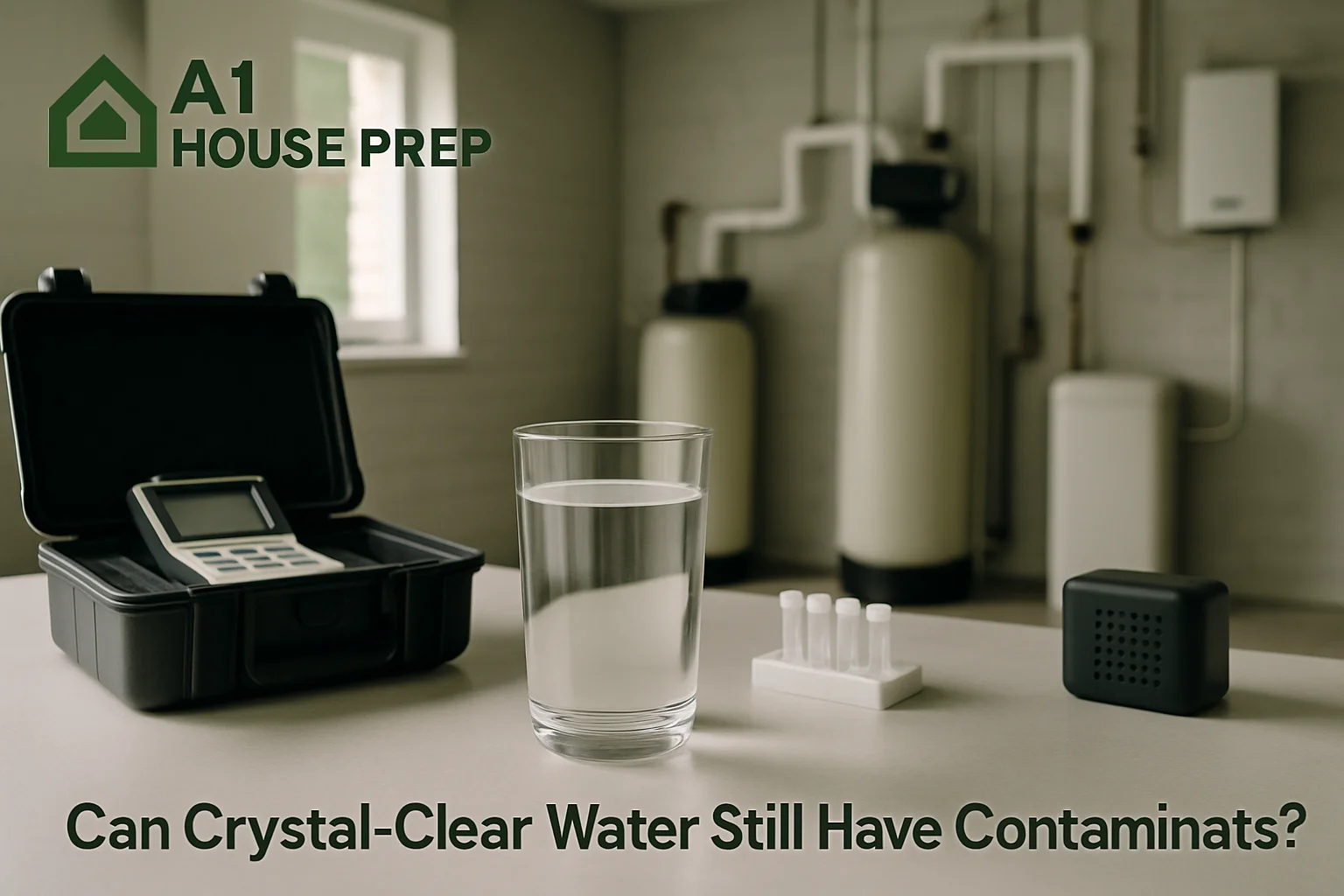
Can Crystal-Clear Water Still Have Contaminants?
It’s one of the most common “quiet questions” homeowners ask after moving in, renovating, or getting a new well: if my water looks clean, tastes fine, and runs clear… do I really need to test it? In Pennsylvania—especially across Montgomery County and Bucks County—many households rely on municipal supplies, private wells, or a mix of older and newer plumbing. The truth is, clear water still have contaminants is not just a catchy concern; it’s a practical reality of modern homeownership.
Clear water can be perfectly safe. It can also carry contaminants you can’t see, smell, or taste. That’s not meant to alarm you—it’s meant to replace guessing with information. At A1 House Prep, we approach water testing the way thoughtful homeowners do: calm, curious, and focused on facts. If you’re in Harleysville, Lansdale, Hatfield, Souderton, North Wales, or Blue Bell (or anywhere nearby), the best way to know what’s truly in your water is to test it.
Whether you’re a homeowner, a buyer doing due diligence, a seller preparing for inspection, or a real estate professional coordinating timelines, this guide explains why clear water can still contain issues, what to test for, and how to use results to make confident decisions.
Why “Clear” Isn’t the Same as “Clean”
Water clarity is mostly about what’s suspended in the water (sediment, rust flakes, visible cloudiness, or heavy mineral presence). Many contaminants, however, are dissolved or present at levels that don’t change appearance. That’s why water can look pristine and still raise questions on a lab report.
- Dissolved contaminants can be invisible (nitrates, some metals, certain industrial compounds).
- Microbial issues may not change color or taste (coliform bacteria can be present without obvious signs).
- Plumbing-related changes can happen inside pipes, not at the source (lead or copper can leach without visible cues).
- Seasonal shifts can affect wells and local water chemistry without noticeable differences at the faucet.
So if you’re wondering whether clear water still have contaminants, the homeowner-friendly answer is: it can—and testing is how you turn “maybe” into “known.”
The Invisible Side of Water: Common Contaminants You Can’t See
The specific risks depend on whether you’re on a private well or public water system, the age of the home, and local conditions. In Montgomery County and Bucks County, we often see homeowners interested in testing for the following categories.
1) Metals (Often Plumbing-Related)
Metals may enter water from the source, from naturally occurring geology, or from household plumbing. They often don’t affect clarity.
- Lead: Can come from older service lines, solder, or fixtures. Water may look perfectly clear.
- Copper: Sometimes tied to corrosion in plumbing. Taste changes can happen, but not always.
- Iron & manganese: These can cause staining and discoloration, but they can also be present at lower levels without obvious visual signs.
2) Nitrates & Nitrites (Common Well-Water Concerns)
Nitrates can enter groundwater through fertilizers, septic systems, and agricultural runoff. They’re typically invisible and can be a key test point for private wells across more rural pockets near Souderton, Hatfield, and surrounding areas.
3) Bacteria & Microbial Indicators
Clear water doesn’t rule out microbial concerns. Many homeowners choose routine microbial screening for wells, especially after heavy rain, plumbing work, or extended vacancy.
4) VOCs and Other Chemical Compounds
Volatile organic compounds (VOCs) and other chemicals can be present without affecting color. Testing options vary depending on concerns (e.g., storage, runoff, local history, or property use). If you’re unsure what’s relevant, a professional can help match the test to your goals.
5) Disinfection Byproducts (Often a Municipal Water Question)
Municipal systems are regulated and treated; that treatment is essential. Some homeowners still prefer to test for certain byproducts and baseline water quality parameters to better understand what’s coming into the home and how the home’s plumbing affects it by the time it reaches the tap.
Premium Homeowner Insight: Your Water Has a “Source Story” and a “Plumbing Story”
Two homes on the same street can have different results—especially if their plumbing differs. Water quality isn’t only about where it starts; it’s also about what happens on the way to your faucet. If your home has older pipes, recent renovations, a new water heater, or long-unused fixtures, testing can provide a clear baseline.
Private Well vs. Public Water in Pennsylvania: What Changes?
In Pennsylvania, many households in Montgomery County and Bucks County rely on public water, while others use private wells—sometimes even in neighborhoods where you wouldn’t expect it. The key difference is responsibility:
- Public water: The utility monitors and treats water at the system level. Your home’s internal plumbing still matters, and testing can help answer “what’s at my tap?”
- Private well: The homeowner is typically responsible for monitoring. Testing is your main tool for staying informed.
If you’re buying a home with a well, selling a property, or managing a transaction, water testing is often one of the most practical “no drama” steps you can take. It turns uncertainty into documentation.
Signs That Suggest Testing (Even When the Water Looks Clear)
You don’t need a crisis to justify testing. Many people test simply because they prefer to know. Still, there are everyday scenarios where testing is especially useful:
- Home purchase or sale (inspection timeline, due diligence, smoother negotiations)
- Older home or older plumbing (especially in established neighborhoods around Lansdale, North Wales, and Blue Bell)
- Recent plumbing work (repiping, fixture replacement, water heater changes)
- Switching from vacancy to occupancy (seasonal homes, rentals, properties that sat empty)
- New well, well service, or pump replacement
- After major storms (particularly for wells; heavy rainfall can impact groundwater conditions)
- Curiosity about taste, odor, or staining—even if it’s mild or occasional
Think of testing as a baseline—like getting a professional evaluation rather than relying on a quick glance.
What Does Water Testing Actually Tell You?
A professional water test can help answer practical, homeowner-focused questions such as:
- Is there evidence of bacterial indicators or general contamination concerns?
- Are metals present at levels that suggest corrosion or plumbing-related contributions?
- Are nitrates a concern for this property’s location and water source?
- Is the water chemistry likely to cause scaling, staining, or corrosion over time?
- Do the results support adding filtration—or do they confirm that what you have is already in good shape?
It’s important to note: a test result is information, not a verdict. If something shows up, the next step is understanding context—source, plumbing, and practical options. If results come back clean, you gain confidence and a reference point for the future.
Why Home Test Kits Aren’t Always Enough
At-home kits can be useful for quick screening, but they’re not always ideal for real estate documentation, detailed analysis, or precise measurements. Some kits are sensitive to handling, timing, and interpretation. If you’re making decisions that affect a purchase, a sale, or a long-term home plan, professional sampling and lab analysis can provide more reliable clarity.
For homeowners in Harleysville, Hatfield, Souderton, Lansdale, North Wales, and Blue Bell, professional testing can also help ensure you’re testing the right things for your water type and local conditions—without over-testing or chasing unnecessary add-ons.
How A1 House Prep Helps Pennsylvania Homeowners Replace Guessing with Facts
A1 House Prep is a Pennsylvania home testing and property preparation company. Our approach is practical and homeowner-friendly: test first, then decide what (if anything) makes sense based on results.
If water quality is on your mind—whether you’re a homeowner, buyer, seller, or agent—explore our Water Testing service for clear next steps.
Related Home Testing & Preparation Services
- Air Quality Testing (helpful for an overall indoor baseline)
- Radon Testing (important for many Pennsylvania homes; testing provides the facts)
- Professional Ozone Machine Rentals (for odor treatment in unoccupied spaces only; always follow safe-use instructions)
A Note on Odors: When It’s Water, When It’s Not
Sometimes homeowners notice an odor and assume it’s “the water,” but odor sources can be broader: drain issues, dampness, HVAC, past smoke, pet odors, or storage odors—especially in basements and lower levels common in this region.
If odor treatment is part of your home-prep plan, A1 offers Professional Ozone Machine Rentals. Ozone can be effective for certain odor situations, but it must be used responsibly:
- Use only in unoccupied spaces (no people, pets, or plants present during treatment).
- Follow all provided instructions for run time, placement, and ventilation.
- Allow time to air out before re-entry, per guidance.
Odor treatment is not a substitute for identifying underlying moisture or ventilation issues, and it’s separate from water quality testing—but many homeowners address both as part of an overall “invisible facts” reset for the home.
Water Testing for Real Estate: A Calm Way to Reduce Surprises
In a transaction, surprises cost time. A water test is one of the simplest ways to create documentation and reduce uncertainty—especially for:
- Well properties or homes with mixed water histories
- Older homes where plumbing materials may vary by renovation stage
- Homes that have been vacant before listing or before move-in
- Buyers who want a baseline for filtration decisions
- Sellers who want to answer questions proactively
For agents and brokers serving Montgomery County and Bucks County, coordinating testing early can help keep timelines smoother—especially when inspections, appraisals, and contractor access all compete for the same window.
FAQ: Clear Water, Contaminants, and What Homeowners Should Know
1) Can clear water still have contaminants?
Yes. Many common contaminants are dissolved or present at levels that don’t change color, clarity, or taste. Testing is the practical way to confirm what’s in your water at the tap.
2) If I’m on public water in Pennsylvania, do I still need to test?
Public water is treated and monitored at the system level, but homeowners sometimes test to understand what’s coming out of their fixtures, especially in older homes or after plumbing changes. Testing can provide a helpful baseline.
3) How often should a private well be tested?
Many homeowners choose routine testing on a regular schedule and additional testing after events like flooding, well service, or long vacancy. The right frequency depends on the well’s history and your household priorities.
4) What are the most common reasons water tests fail in real estate transactions?
It varies by property and water source, but common issues include microbial indicators, nitrates, or certain metals. A calm approach is to test early, interpret results correctly, and plan next steps (if needed) without rushing.
5) Can taste and odor be reliable indicators of water quality?
Sometimes, but not always. Some water with noticeable taste/odor can be harmless nuisance-level chemistry, while some water with no taste/odor can still show concerns on a lab test. Testing replaces guesswork.
6) Will a water filter solve everything?
No single filter is “one-size-fits-all.” The right solution depends on what your testing shows and where the issue originates (source vs. plumbing). Testing helps prevent overbuying or choosing the wrong system.
7) What should I do before a water test?
Follow the sampling instructions you’re given. In general, you’ll want to avoid unusual activity that could skew results (like heavy flushing) unless directed. For certain tests, first-draw vs. flushed samples can matter—especially when evaluating plumbing contributions.
Ready to Stop Wondering and Start Knowing?
If you’re in Montgomery County or Bucks County—Harleysville, Lansdale, Hatfield, Souderton, North Wales, Blue Bell, or nearby—A1 House Prep can help you get clear, practical answers with professional Water Testing.
Call A1 House Prep: 215.853.8226 or Request Service to schedule.
Testing doesn’t have to be stressful. It’s a smart, homeowner-focused way to understand your property—especially when the water looks perfect but your curiosity says, “Let’s confirm.”